


Why AI Won’t Be a Real Help in Matchmaking

A Case for More Humanity, Chance, and Real Connection
Artificial intelligence is everywhere these days. It’s supposed to make our lives easier, optimize our decisions, and understand us better than we understand ourselves. Dating apps and matchmaking sites are jumping on the bandwagon, promising that AI will transform how we find partners—with smarter algorithms, better recommendations, and a more efficient way to sort through potential matches.
At freshSingle, we’re skeptical. Finding a partner isn’t an optimization problem. It’s personal, emotional, and full of surprises. That’s why no machine will ever fully take it over.
When Dating Turns Into Pure Optimization
Online dating has changed a lot since the early 2000s. What began as a simple new way to meet people slowly turned into a highly optimized business model.
Feature after feature got added: endless swiping, automated suggestions, premium filters, and clever psychological tricks designed to keep people scrolling as long as possible. Most of these “improvements” haven’t made dating better.
Instead, the whole experience has gotten faster, more superficial, and more disposable. People get judged in seconds based on a handful of photos and a short bio. One swipe left or right decides whether someone even gets a chance at a real conversation.
The big dating companies benefit the most. More options mean people stay longer. More features mean it’s easier to sell premium subscriptions. But bigger profits and market share don’t automatically mean singles have better odds of finding a real relationship.
The Alienation of a Generation
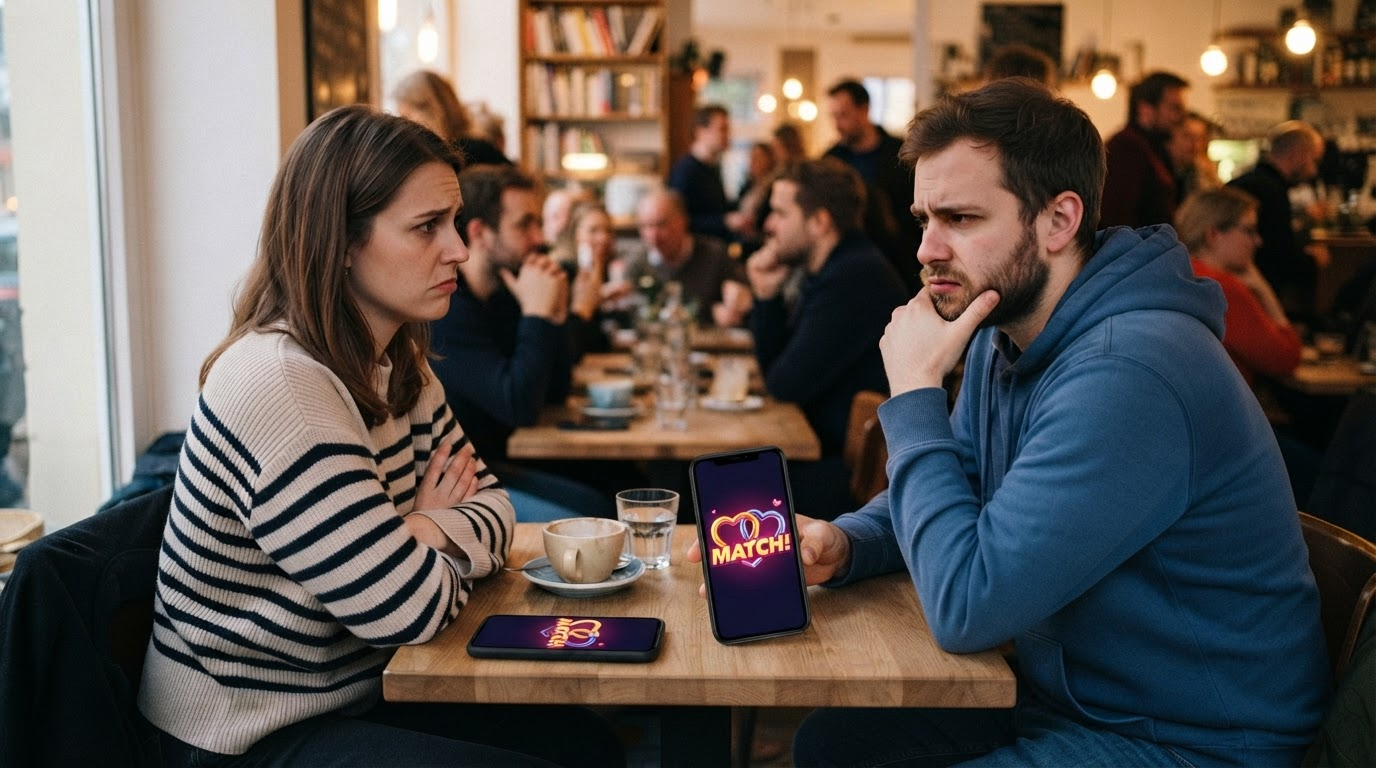
In the last few years, it’s become clear that a lot of people—especially Gen Z—are growing tired of dating apps. All the new features and promises of smarter matching haven’t created more closeness. They’ve created frustration, overwhelm, and a feeling that everyone is interchangeable.
Many singles find online dating exhausting. They feel constantly evaluated, compare themselves to endless profiles, and get lost in a sea of options. What starts as a search for connection often turns into a competition for attention.
So the real question is: Will more technology actually make dating more human? Or will it push us even further away from what getting to know someone is really about?
What We Can Learn From the Past
Meeting people used to happen more slowly and more naturally. You met through friends, at events, at work, or through shared interests. There were no profiles, no compatibility scores, and no algorithm deciding who might be right for you.
It wasn’t perfect. But it left room for chance, for subtle chemistry, and for real encounters. That’s the idea behind slow dating: not rating as many people as possible as fast as possible, but taking the time to actually get to know someone.
The Blind Spot of AI
AI can certainly help with some things. It can analyze profiles, pre-sort matches, spot shared interests, or help start a conversation.
But here’s the problem: What happens to the people the AI filters out?
Maybe the right person was in that pile. Maybe someone doesn’t look perfect on paper but is perfect in real life. Attraction doesn’t always come from matching interests. Sometimes it comes from humor, presence, a little friction, or an unexpected connection.
No algorithm can reliably predict how two people will feel when they actually talk. It can’t capture whether someone really listens, what a smile feels like in person, or whether that special spark is there.
Opposites Attract
“Birds of a feather flock together” has some truth to it. Shared values, interests, and goals can be a strong foundation. But “opposites attract” is just as true. People don’t always fall for someone who looks most like them on paper. Sometimes the difference is exactly what makes someone interesting.
Perfect compatibility can even feel boring. Good relationships need curiosity, growth, and the willingness to learn from each other. An algorithm that only looks for maximum similarity might filter out the very connections that aren’t predictable—but still work.
A Calculated Match Isn’t a Real Connection
Even the best AI match is still just a calculation. It can list common interests and estimate probabilities. But a real connection only happens when two people talk, meet, and spend time together.
A perfectly pre-sorted match doesn’t automatically become chemistry in real life. Between theoretical compatibility and actual attraction sit a lot of things that can’t be reduced to data points.
Love isn’t fully measurable. Closeness can’t be calculated. And trust doesn’t come from an algorithm—it grows through shared experiences.
Technology as a Door-Opener, Not the Decision-Maker
This doesn’t mean we should reject dating apps and matchmaking sites. The internet can be genuinely useful. It can introduce people who might never have crossed paths otherwise.
But these tools should only open the door. The decision about whom we actually want to get to know should never be left entirely to a machine.
Technology can create possibilities. It shouldn’t decide which possibilities we’re even allowed to see.
What freshSingle Stands For
At freshSingle, we believe in a different approach—one that doesn’t reduce people to data, photos, and probability scores. We want space for real encounters, personal choices, and unexpected connections.
Sometimes it’s the difference that makes the difference.
That’s why the future of dating shouldn’t be more complex algorithms. It should be more humanity. Less swiping. Less filtering. Less pressure to optimize. Sometimes less really is more.
Instead, we need more time, more openness, and more courage to get to know someone who might not fit perfectly into a search filter—but who fits perfectly into real life.
Related Posts


